

The global demand for specialized waterproof footwear has shifted toward high-performance materials that can withstand extreme maritime and industrial environments. For professionals operating on wet surfaces, the intersection of traction, durability, and moisture protection is no longer optional but a critical safety requirement. In this context, the legacy and technical approach of a wellington rubber company provide essential insights into how rubber compounding affects long-term equipment reliability.
The primary challenge for deck-based operations is the "slick surface" paradox: materials must be flexible enough for movement but rigid enough to provide structural support, all while maintaining a coefficient of friction high enough to prevent slips. Traditional rubber boots often fail at the seams or lose their grip over time due to material degradation from saltwater and chemical exposure.
This analysis examines the engineering specifications of modern rubber deck boots, the importance of non-slip outsole patterns, and how selection criteria should be prioritized for industrial procurement. We will explore the technical architecture of footwear designed for high-moisture environments to help buyers distinguish between fashion rainwear and professional-grade utility gear.


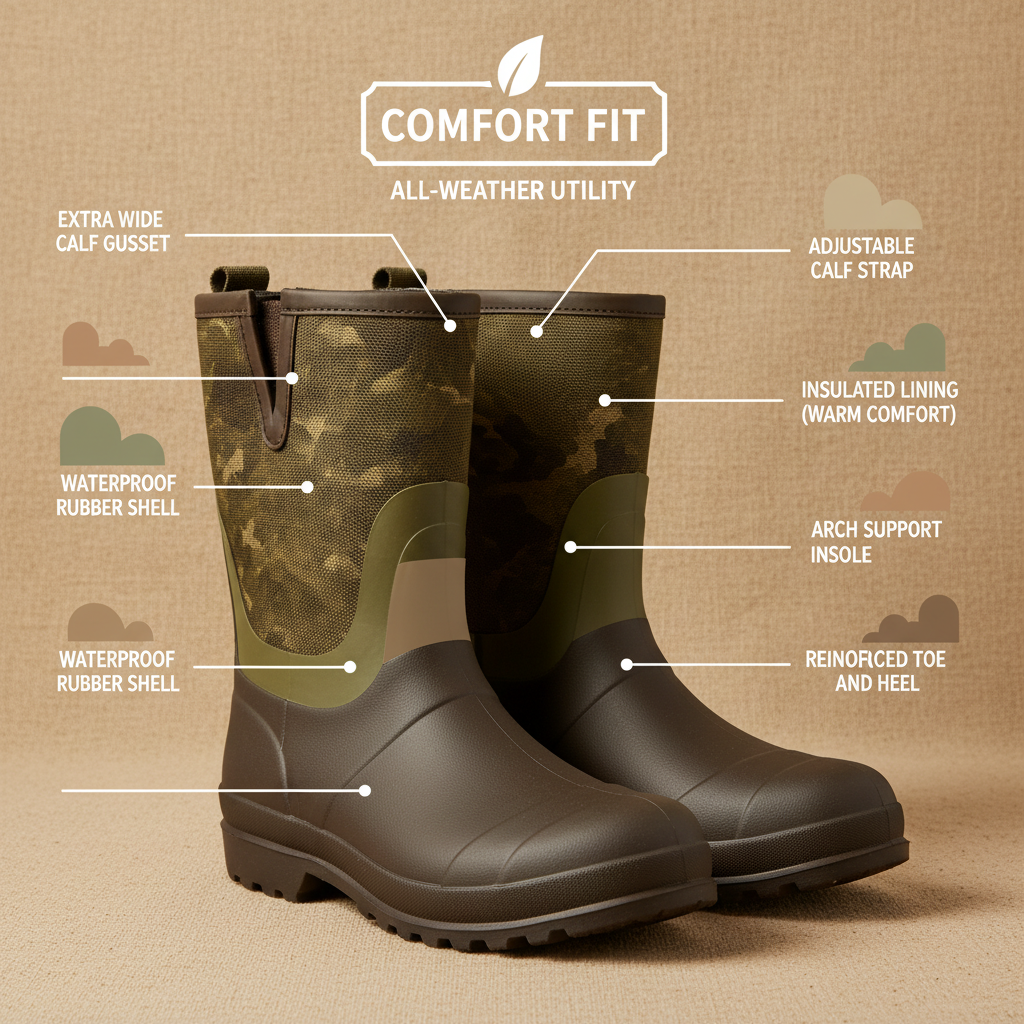
The structural integrity of professional rubber boots depends on the synergy between the outer rubber shell and the internal lining. High-grade rubber must be environment-friendly yet maintain a balance of flexibility and durability to prevent cracking during repetitive flexion.
Integrating cotton linings enhances breathability and comfort, which is vital for long-shift operations. This dual-layer approach ensures that while the exterior remains 100% waterproof, the interior manages moisture and heat, reducing the risk of dermal irritation for the wearer.
Technical specifications for professional footwear go beyond simple sizing. For instance, the inclusion of a rounded toe is an engineering choice to prevent toe crowding, while a thick foam midsole combined with a cushioned insole is designed specifically for shock absorption during walking on hard, wet decks.
The adjustable closure at the top-line, typically utilizing a lace system, allows the user to tighten the boot opening. This is a critical feature for preventing water ingress and stopping debris from entering the boot in chaotic industrial or fishing environments.
From a sizing perspective, covering a broad range from EU36 to EU47 ensures versatility across different labor forces. However, the true value lies in the "removable insole" design, which allows for easy cleaning and replacement, extending the overall lifecycle of the boot.
The outsole is the most technically demanding component of any waterproof boot. In marine environments, the primary goal is to maximize the lockdown grip on surfaces coated in oil, water, or fish slime.
When evaluating a wellington rubber company product, the focus should be on the depth and geometry of these treads, as they determine the boot's efficacy in diverse outdoor activities beyond just fishing.
To quantify the effectiveness of rubber boots, engineering teams often use normalized scores to compare different material configurations across key performance indicators. These include waterproof integrity, slip resistance, flexibility, and thermal comfort.
The following assessment provides a relative engineering rating for various rubber boot configurations, highlighting how specialized deck boots outperform general-purpose rain boots in professional settings.
A typical deployment scenario for professional rubber deck boots is found in commercial fishing fleets where operators are exposed to constant moisture and abrasive surfaces. In these environments, the ability to customize colors allows for fleet standardization and visibility, while the rubber's resistance to salt-water corrosion ensures the boots do not degrade prematurely.
Beyond maritime use, these boots are increasingly deployed in aquaculture, flood management, and heavy-duty agricultural operations. The key to successful deployment is matching the boot's specification—such as the thickness of the midsole—to the specific impact levels of the working surface.
The industry is currently moving toward the integration of bio-based rubber compounds that reduce environmental impact without sacrificing durability. The goal is to maintain the 100% waterproof standard while improving the biodegradability of the footwear after its service life.
Another emerging trend is the use of adaptive tread patterns that can adjust their grip based on the viscosity of the liquid on the surface. While still in development, these "smart outsoles" could redefine safety standards for the wellington rubber company sector.
Finally, the shift toward modular linings is expected to grow, allowing users to swap cotton linings for thermal or antimicrobial materials depending on the season and environment, thereby extending the utility of a single pair of boots.
Procurement officers should not evaluate waterproof footwear based on cost alone. A comprehensive selection process must weigh the trade-offs between material flexibility and sheer durability.
The following matrix provides a framework for selecting the appropriate rubber boot configuration based on the operational profile of the end-user.
By aligning the boot's technical attributes with the specific challenges of the application—such as the need for lockdown grip or shock absorption—organizations can optimize both worker safety and equipment ROI.
| Configuration Type | Primary Material | Traction Level | Recommended Use Case |
|---|---|---|---|
| Basic Utility | Standard Rubber | Moderate | Light Rain / Gardening |
| Standard Industrial | Reinforced Rubber | High | General Warehouse / Wet Floors |
| High-Duty Deck | Premium Marine Rubber | Maximum | Commercial Fishing / Boat Decks |
| Precision Safety | Composite Rubber | High | Laboratory / Chemical Handling |
| Outdoor Adventure | Flexible Rubber | Moderate-High | Hiking / Fishing / Hunting |
| Industry Baseline | Mixed Polymer | Moderate | Standard Rain Protection |
100% waterproof ratings in professional rubber footwear refer to the complete absence of permeability through the primary shell material and the seamless integration of the outsole. This is achieved through advanced vulcanization processes that fuse the rubber components into a single, monolithic structure, ensuring that water cannot penetrate the seams even under pressure.
The non-slip pattern works by creating channels that rapidly displace liquids (water, oil, slime) from beneath the sole. By moving the liquid away from the contact area, the rubber can make direct contact with the deck surface, increasing friction. The specific geometry of the tread—often featuring deep siping and multi-directional lugs—optimizes this displacement regardless of the direction of movement.
An adjustable closure, such as a lace-up top, allows the wearer to customize the fit to their calf size. This prevents "gap leakage," where water or debris enters the boot from the top during deep splashes or while wading. In industrial settings, this seal is crucial for maintaining dry feet, which prevents blisters and reduces the risk of fungal infections during long shifts.
Yes. While originally designed for the fishing industry, the combination of 100% waterproofing, non-slip soles, and durability makes them ideal for various outdoor activities. This includes hunting, farming, flood response, and any professional application where the user is exposed to wet, slippery, or muddy environments that require heavy-duty protection.
Removable insoles serve two primary purposes: hygiene and customization. Because rubber boots can trap heat and moisture, the ability to remove the insole allows for thorough drying and cleaning, which prevents odor and bacterial growth. Additionally, it allows users to replace the standard insole with orthopedic inserts for improved arch support or additional cushioning.
When selecting from the EU36-47 range, it is important to account for the lining thickness. Since these boots often feature cotton linings and are worn with thick socks, a slight clearance in the toe box is recommended to prevent crowding. The rounded toe design specifically helps alleviate this, but buyers should verify the internal length against their standard footwear size.
The transition from basic rainwear to professional-grade waterproof footwear requires a deep understanding of material science and interface engineering. By prioritizing non-slip tread geometry, shock-absorbing midsoles, and seamless rubber construction, users can significantly reduce the risk of slips and falls in maritime and industrial environments.
Ultimately, the value of a wellington rubber company solution lies in its ability to solve the specific pain points of the professional operator: keeping the wearer dry, stable, and comfortable under extreme conditions. For organizations looking to upgrade their safety equipment, focusing on these technical benchmarks is the only way to ensure long-term reliability.